The Dust Did Roar

A Collection of Poetry and Essays on Science, Love, and Cheese

  • To my great shame, I have never read A Long Walk to Freedom.

    Growing up in South Africa, the story of Mandela is so wrapped up in the story of the country itself, reading his biography can feel unnecessary. I thought I knew all there was to know about his life.

    That’s why I was surprised when, while attending a Sunday morning service at St George’s Cathedral, I was deeply affected by a detail shared by the presiding pastor.

    He mentioned a painting drawn by Mandela after his release, in which he illustrated the view from his jail cell on Robben Island. The pastor described the all too familiar silhouette of Devils Peak, Table Mountain, and Signal Hill, that are shown through the bars. But as the pastor quickly noted, and which I had already realised, this is not actually the view one can see from cell 46664. Having been to Robben Island several times, I knew that this window only looked down into the prison courtyard.

    I was truly surprised when I found myself tearing up.

    Being born and raised in Cape Town, the site of the mountain has always given me a great sense of comfort and safety. When returning from a trip overseas, I never truly felt at home until I could glimpse those green and grey slopes during the car ride back from the airport.

    If you lookup the other drawings in this series by Mandela, they all depict various parts of Robben Island, like the harbour or the chapel, in a relatively realistic fashion. Mandela’s choice to depict the view from his cell window as the distant land that he surely hoped to return to one day, struck me very deeply.

    I’ve not made it a secret that this year has been a awful one for me, and I have often caught myself during the course of this year, being unable to look ahead and think about the future. I have been so bogged down in the troubles of the present, I was staring at my feet unable to take the next step along the road.

    The thought of Madiba choosing to see this symbol of defiance and freedom rather than the confines and hardships of his prison, effected me greatly.

    We might not be given a choice in the windows we are given in life, but we are always free to choose the view we see through them.

    The Window by Nelson Mandela

  • In the Beginning, they said
    there was nothing.

    To me, the Universe was
    born with your smile.

    René said she strode
    from my own mind.

    Now she is gone,
    playing in another’s Dreams.

    Albert wrote that days
    would quicken at her approach.

    Yet it always feels
    like Twilight in her absence.

    Isaac decreed my walls
    would fall at her gaze.

    But her scent,
    would lift me to the Heavens.

    Kurt showed not even
    the great sage can know all.

    Deep within her eyes,
    I could swim within Eternity.

    Stephen pictured the darkest
    corners filled with light.

    In my heart, only the
    Ghost of her radiance remains.

    Edwin observed,
    the fleeing of the stars.

    Like her laughter,
    an Echo slowly fading away.

    Niels measured the
    distance between things.

    Now I know why
    her Touch felt so soft.

    I had the idea for this poem while I was dating someone. It was a super nerdy expression of devotion. But before I could actually write it down, the relationship ended abruptly. Several months later, I decided to create the poem anyway, thinking it might help me find some sort of answer. But as I began to write the first words, it quickly evolved into something very different to my original idea. I had changed as a person therefore, the poem had to change with me.

    In some ways, I am sad that I never wrote that original version. But if I had, the version that you see above would never have existed. The title ‘I Know They’re Wrong’ doesn’t make sense for the poem as it is today, but I decided to keep it as a way to honour that version of me that had the original idea. Me before the heartbreak.

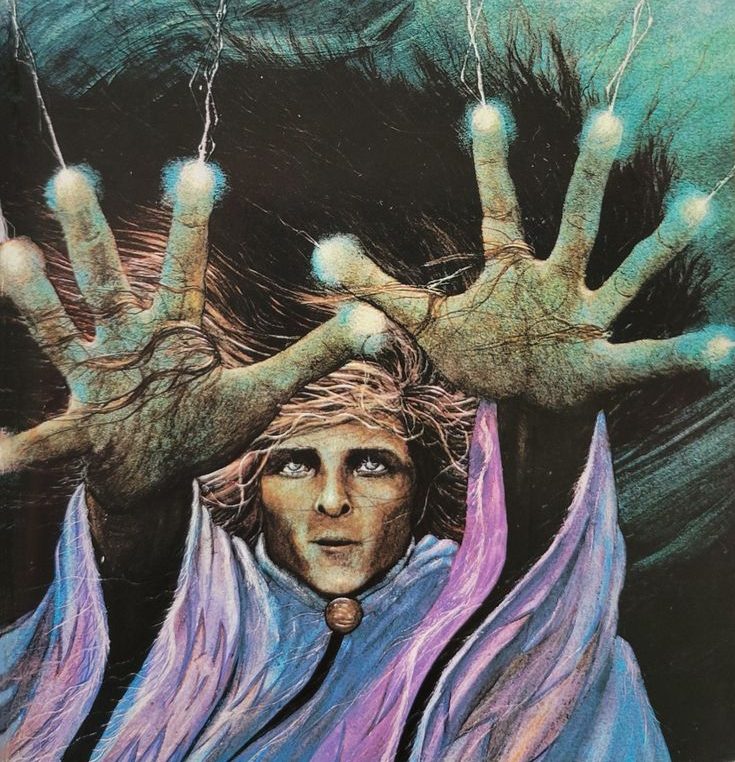
    Art changes over time. Despite what we may think, it’s never static. One of my favourite books when I was younger was the Earthsea Trilogy. It depicts a fantastical archipelago of islands containing dragons, wizards, and shadowy demons. The original three books were written between 1968 and 1972 by Ursula Le Guin. Years later she decided to revisit the world of Earthsea, largely because of the criticism the male-oriented nature of the first trilogy received. As a response, she wrote the novel Tehanu, a deeply reflective book on the place of women in society. She later wrote the final book of the Earthsea series, The Other Wind, which upended the very concepts the original novels were based on.

    By the final lines, I found the world that I loved as a child far richer than I could have imagined before and I only wished that I could express my gratitude to Mrs. Le Guin for allowing me to join her on this journey.

    Cover of Earthsea Trilogy by Ursula Le Guin

  • I’m a very anxious person.

    Worrying about what other people think of me, or rather what I think other people think of me, takes up far more of my life than I would like to admit. I once went a whole year without using my locker at school because it happened to be located just outside the girls change-room and I was terrified everyone would think I was a pervert.

    But there is one aspect of my life that has somehow become immune to these constant thoughts of worry.

    Dance.

    Now, I would hardly call myself a great dancer. Even a good dancer would be a stretch. But unashamed and confident? Most certainly.

    I didn’t start out this way, of course. The first time I went to a club, I had a mini panic attack while walking home convinced that every single person on that packed dancefloor could see how terrible I was.

    But I kept doing it even though I was constantly aware that I had no idea what I was doing and that there was always someone else on the dance floor who clearly did know and was better than me.

    At some point, I can’t exactly remember when, I began to think about why I kept dancing despite the constant fear of being judged.

    I came to the conclusion that even with all the social pressure I felt and the worry that I would do the wrong thing, dancing actually made me feel good.

    Becoming one with the beat, throwing my head back, mouthing the few lyrics that I actually knew.

    These were small moments I no longer felt that dark presence that always appears whenever I am at my lowest.

    So I finally told myself “Fuck it, who cares if others think that I’m a freak with zero coordination? I’m going to have a good time with or without their perceived approval.”


    The irony of this change in attitude only became apparent several years after this moment when I was attending a friend’s wedding. I had danced for hours with friends and strangers alike, soaked with sweat, and feeling the sweet siren song of my hotel bed.

    As I was saying my goodbyes to the bride and groom, they both thanked me profusely for the all the fun and ‘gees’ that I had brought to the wedding. My commitment to having fun and being unashamed to share it with those around me had made their special day just a little bit more special.

    By deciding that I didn’t care if I pleased others or not, I ended up getting exactly what I wanted all along.

    So like Chappell Roan said, I’m gonna keep on dancing.

    “Pink Pony Club” by Chappell Roan
  • Who will sing her to sleep,
    when all the candles are burned,
    when all the winds have died?
    
    Eons after the choir is silent,
    does not their chorus echo,
    in the dark and in the deep?
    
    Through crumbled halls,
    and broken rings,
    the sound still stalks.
    
    From one tiny corner,
    long past its end,
    the song still calls.
    
    A billion souls and a billion more,
    did labour and bare,
    not knowing their part.
    
    The fullness of Creation,
    the greatest play of all,
    to show at last,
    the dust did roar.

    Being proud of my work is not something that comes easy to me. But when I completed the above poem, I confess that I did manage to feel a sense of creative joy, particularly spurred by the last line. I remember googling the words convinced that I had read it somewhere before and was merely regurgitating it unconsciously. When I couldn’t find anything remotely similar, I had to come to terms with the fact that I had created something original and that I liked it.

    The poem ponders whether there will be any sign that of humanity ever existed when the universe reaches its inevitable heat death and if there is even meaning to the various works of humans when a cold and silent universe is all we can ever expect to survive. I was inspired the famous painting of Alan Lee that depicts the fellowship of the ring passing through the long abandoned great halls of the dwarf kingdom Moria. I tried to imagine travellers in the far future walking through the ruins of humanity and what they would think of the results of all our toils.

    The Eastern Arches by Alan Lee

  • Hope that you will join me on this journey, sharing my poetry both old and new, as well as some essays that already have some great ideas for. Happy scrolling!